
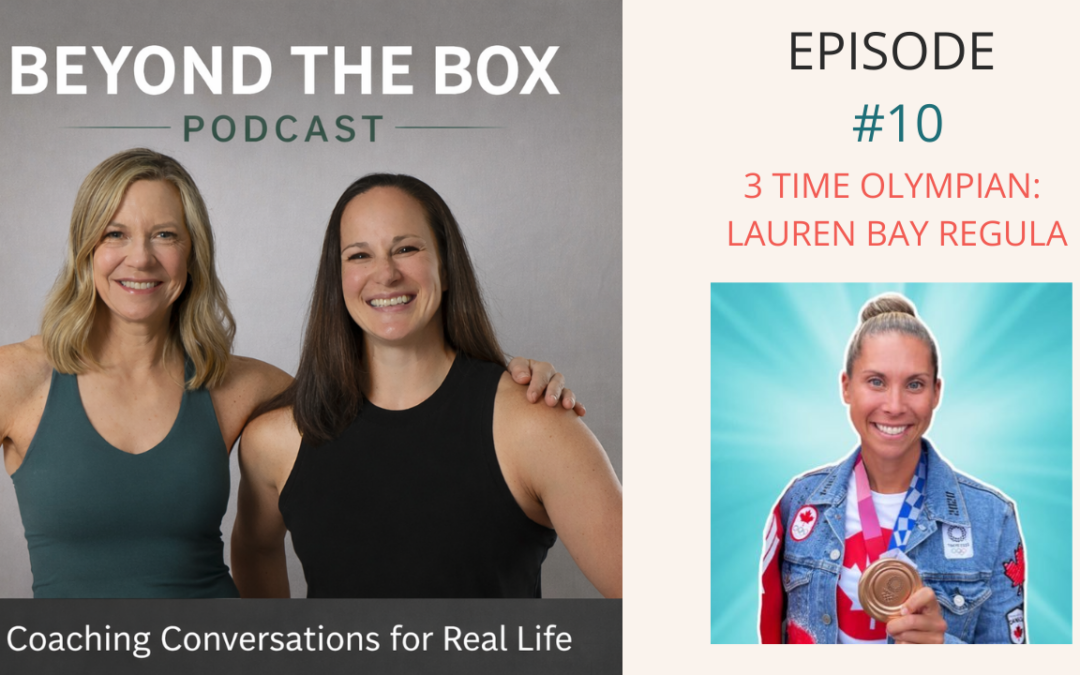
From Three-Time Olympian to Depression and Back: Lauren Bay Regula on Building a Life You Actually Own
Strong Moms co-founder Lauren Bay Regula joins Gwen and Sheena to talk about the health triangle, the myth of positive thinking, and why the boringly beautiful basics will always win.
“I’ve been sub 10% body fat and fricking miserable. So it’s like — we’ve met people who lost 30 pounds and all the things that got them there in the first place were still there because they were never addressed.” — Lauren Bay Regula
Lauren Bay Regula is a three-time Olympian, co-founder of Strong Moms, and one of Sheena’s former Team Canada teammates. She’s also someone who went from the highest level of her sport to a years-long battle with depression — and came out the other side with a framework for health that goes far deeper than what you eat or how you train.
This conversation covers the health triangle, the power of “I am able,” why journaling divides people, and the one mindset shift that unlocked everything else in Lauren’s life.
The Health Triangle: Physical, Mental, Emotional
Strong Moms doesn’t just coach workouts and nutrition. Lauren built the program around three interconnected pillars — physical health, mental health, and emotional health — and she’s clear about why all three matter.
Here’s how she defines them:
Physical is the obvious one. Movement, nutrition, your body.
Mental is logistics — planning, systems, habits, routines. The discipline to structure your days. No emotion required, just execution.
Emotional is how we relate to our feelings. And Lauren is quick to point out: emotions aren’t good or bad. They’re data. Anxiety isn’t a problem — anxiety in the wrong context is. When she was deep in depression, she was too anxious to order a pizza. That’s anxiety not matching the situation. A great white shark coming at your boat? That’s anxiety doing exactly its job.
The reason the triangle matters is that every mom comes in with a different strength. Some are physically locked in but drowning in mental noise. Others have their days completely organized but haven’t moved their bodies in years. Others are emotionally intelligent but have never once carved out time for themselves.
“We’ve had moms come in and it took them an entire year to lose enough emotional weight to finally have the brain space to put towards the physical. And it took them two years to go down 30 pounds. But what would have happened if we just said — just work out, just eat different?”
“I Am Able” — The Mantra That Actually Works
Lauren spent years trying to write positive affirmations in her journal and feeling like a fraud doing it. Writing I am strong when you don’t believe it doesn’t work. It makes things worse.
Her therapist offered a reframe that changed everything: start with I am able.
Because no matter how low the day, that’s true. You made it through. Your kids are okay. Your marriage is intact. You’re still here. I am able is something you can write down and mean — fully — even on your worst days. And that small foothold of genuine belief is enough to build on.
Lauren still goes back to it. Not as a relic of a harder time, but as a real tool she reaches for when she needs it.
Brain Dumping: For the Moms Who Hate Journaling
Journaling is polarizing in Strong Moms. Lauren doesn’t fight it. Instead, she offers something almost no one can argue with: the brain dump.
Here’s the practice: get everything out of your head and onto paper. The mundane, the anxious, the petty, the grateful — all of it. Don’t filter. Don’t craft. Just write.
Then look at it.
Vision is our most powerful sense. When something is floating around in your head, it feels enormous and shapeless. When you can see it on paper, you can evaluate it. You can cross out the things that aren’t true. You can circle what you actually have control over. You can identify what needs attention this week.
“We have moms who sit there for five minutes and get two sentences. They’re thinking, I don’t know what to say. And I tell them — that’s exactly what you should be writing.”
The physical act of writing slows your brain down. The physical act of crossing something out — even something as simple as a thought you’ve been carrying for months — creates a release that’s hard to explain until you’ve done it.
Boringly Beautiful: The Case Against Complexity
Instagram wellness culture thrives on novelty. New protocols. New superfoods. New movement trends. Lauren has one response to all of it: do you want results, or do you want to be entertained?
The concept of “boringly beautiful” came from her third Olympics. Their catcher stood up before a training session and told the team: the squad that wins the podium is going to be the one that does the basic things the best. Not the fanciest things. The basics, done well, done consistently.
It applies to everything.
Moms in year five of Strong Moms sometimes come back after a rough stretch and say they feel like they’re starting over. Lauren’s response: your checklist still has the basics on it. That’s not failure — that’s proof you know exactly what works for you.
“Do you want results or do you want to be entertained? Because if you squat once every four weeks and every workout is different, I can’t tell you I feel good about the results.”
Bored with your workout? Change the playlist. Text a friend to join you on FaceTime. Add one new movement at the end. But don’t replace the things that actually work with things that just feel new.
Environment Is the Invisible Hand
Lauren is a big James Clear person — and one of his ideas runs through everything she does: your environment is an invisible hand that shapes you. You don’t feel it shaping you. It just does.
Who you spend time with. What your home feels like. The energy in your relationships. All of it is quietly informing your thoughts, your decisions, your behavior — whether or not you’re aware of it.
For Lauren, the clearest example of this is her husband Dave. During her depression, she shut him out completely. Not from resentment — from a misguided sense of protection. She thought she was doing him a favor by not burdening him. What she was actually doing was robbing him of the chance to help and isolating herself in the process.
“All he wanted to do was help me. And I was robbing him of the opportunity because I didn’t say anything. When you find your people, they’re not going to say you’re taking from me. They want to help.”
Asking for help isn’t weakness. In Lauren’s words, it might actually be the bigger flex.
What She’s Most Proud Of
It’s not the Olympics. It’s not the business. It’s not the medals.
What Lauren is most proud of is the moment she decided she had the ability to change — and actually believed it.
She went from black-and-white thinking, victim mentality, and bracing for homelessness to owning a life she genuinely loves. That mindset shift is also what made her third Olympics possible. She couldn’t have said yes to it before. She didn’t have the internal foundation to stand on.
“The best is always in front. I believe that. Always in front.”
What This Means for You
If you’ve ever felt like you were doing all the right things and still not getting anywhere — Lauren’s framework might explain why. The physical piece is only one third of the equation. The mental and emotional weight you’re carrying has to be addressed too, or the physical work won’t stick.
You’re not broken. You might just be building from the wrong point of the triangle.
Start with one thing. Make it boring. Make it small. Make it something you can actually do on your hardest day.
I am able is enough to start.
Ready to stop starting over and start building something that lasts?
We work with women who are done white-knuckling plans that don’t fit their real lives. Nutrition and fitness support built around your actual body, your actual schedule, and where you actually are right now. Let’s talk.
Follow Lauren:
- https://strongmomstrongfam.com/
- @laurenregula IG
- @strongmommethod IG
- @laurenregulathestrongmommethod