

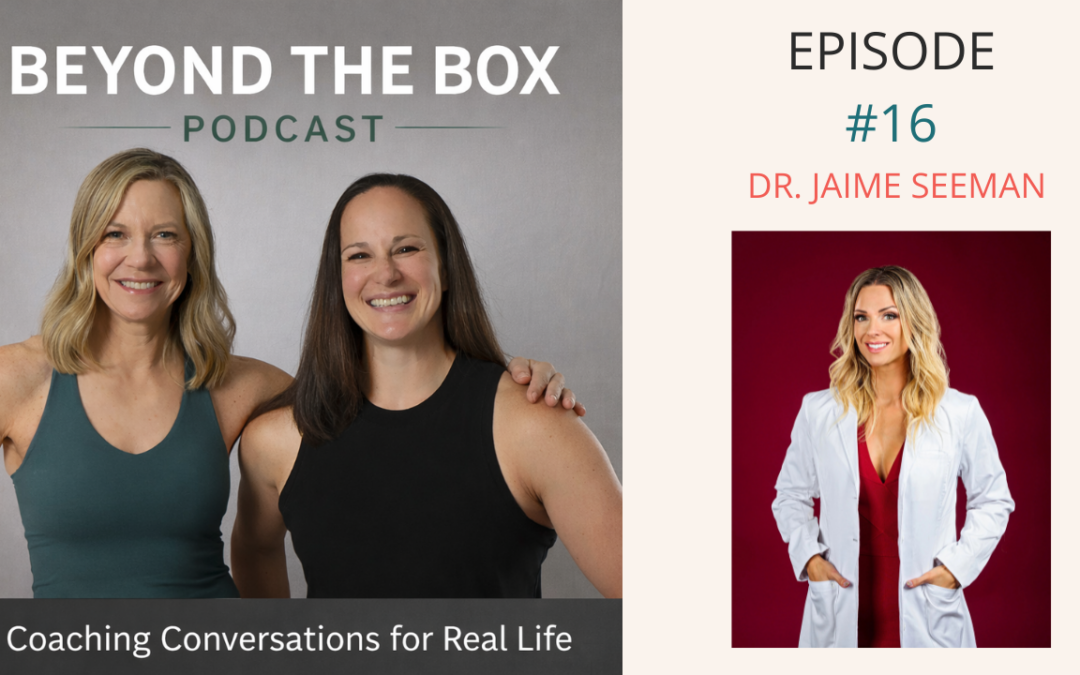
Dr. Jaime Seeman, known online as Dr. Fit and Fabulous, is a board-certified OBGYN, menopause specialist, Titan Games competitor, mom of three, and the author of Hard to Kill. She’s also a former University of Nebraska teammate of our co-founder Sheena, which made this conversation feel less like an interview and more like two women who’ve been in the trenches comparing notes on what actually works in perimenopause. If you’re a woman in midlife who’s tried everything and feels like your body is suddenly playing by rules nobody taught you, this episode is for you.
A quick note: Sheena had a technical hiccup and dropped off around the 21-minute mark — but Gwen carried the rest of the conversation, and Jaime brought enough wisdom for three episodes.
The goldfish cracker era
Here’s the part that should make every woman exhale: Jaime graduated from Nebraska with a degree in nutrition and exercise science, headed to medical school, and still ended up pre-diabetic, on thyroid meds, and counting goldfish crackers in a notebook trying to drop ten pounds. A doctor. With a nutrition degree. Insulin resistant.
Her story is the story we hear from our clients constantly — smart, capable, knowledgeable women who did what they were told (control calories, do more cardio, shrink yourself for the wedding) and watched their bodies stop cooperating. Jaime left college as a two-time lifter of the year and immediately wanted to get rid of the muscle. Then came three pregnancies, a failed glucose test, a hypothyroidism diagnosis, and a moment of reckoning: if she — with all her training — could end up here, the system itself was broken.
What pulled her out wasn’t a new diet hack. It was rebuilding from two directions at once: lowering her carbohydrate intake to address insulin resistance, and — eventually — getting back under a barbell. Today her A1C sits at 4.9, her fasting insulin is low, and she’s off thyroid meds. Not because she found the secret. Because she stopped trying to shrink herself and started trying to be strong.
Muscle is an endocrine organ — and your glucose problem is a muscle problem
This is the line that should be tattooed on every perimenopausal woman’s forearm. Jaime explained it plainly: muscle isn’t just there to lift things over your head. It’s an endocrine organ that talks to your brain, your fat cells, and every other organ in your body. It’s also the largest disposal site for glucose. So when you lose muscle — through years of cardio, calorie restriction, or just not lifting anything heavier than a tote bag — your body literally loses its capacity to handle blood sugar well.
“If you have a glucose problem, you have a muscle problem. Your muscle is not healthy. It’s not bringing in glucose and storing glycogen like it’s supposed to. And then what it does is starts depositing fat within the muscle.” — Dr. Jaime Seeman
This reframe matters because so much of what gets called a metabolism problem in midlife is actually a muscle problem in disguise. Fatty liver, fat around the pancreas, blood sugar that won’t behave — these aren’t separate issues. They’re downstream of tissue that stopped doing its job because nobody asked it to do its job for twenty years.
And no, walking doesn’t count. Jaime was direct about it: walking is necessary to live, but it isn’t exercise. Cardio is great for VO2 max and heart health. But if you want to change body composition, protect your bones, and keep your metabolism functional through perimenopause and beyond, resistance training is the only non-pharmacological intervention that consistently delays age-related decline in muscle mass, strength, and power. The treadmill cannot do this for you. Neither can the elliptical. Neither can pilates alone (though we love it as an add-on).
You don’t need a 400-pound barbell. You just need to start.
The image most women have of “lifting” is a CrossFit gym, a barbell on someone’s back, and a vibe that says not for me. Jaime spends a real chunk of her clinic time gently dismantling that picture. There’s a published study on women 65 and older who did an eight-week program with nothing but resistance bands — and saw improvements in gait speed, stability, and metabolic markers. Resistance bands. Eight weeks. Sixty-five and up.
The barrier isn’t physical capacity. It’s the mental picture. So Jaime — like we do with our BTBN clients — starts wherever the woman in front of her is willing to start. Five-pound dumbbells. A pushup on the wall. A side plank with a weight on her hip. The point isn’t the load. The point is consistent, progressive stimulus that asks the muscle to adapt.
And as Sheena pointed out before she dropped off: change the language and watch women perk up. Nobody wants to “bulk up.” But “what are you doing to get toned?” — suddenly everyone leans in. Tone is just muscle that exists and gets used. Call it whatever you need to call it. Just start.
HRT is one puzzle piece, not the whole puzzle
A huge portion of this conversation was Jaime — an OBGYN who prescribes hormones every day — pushing back on the idea that HRT is a magic bullet. She uses a metaphor we loved: a kid’s puzzle with eight pieces. HRT is one piece. If she just hands you that piece and sends you on your way, you don’t have a picture. You have a piece.
In her book Hard to Kill, Jaime lays out five pillars for perimenopausal health: nutrition, training, sleep, stress management, and relationships. HRT slots in on top of those pillars. She put it this way: HRT works best in a system that’s already functioning metabolically well. If a woman comes in with hypertension, insulin resistance, terrible sleep, and a bottle of wine a night — hormones will help a little, but they cannot do the heavy lifting alone.
This is the thing the hormone-clinic-on-every-corner moment is getting wrong. Access to HRT is a massive win. But “here’s your prescription, see you in six months” without addressing nutrition, lifting, sleep, and stress is just a different flavor of the same dismissive medicine that left so many women feeling unseen in the first place. We see this constantly with our clients — women come in expecting a hormone fix and discover that the hormone fix only works when the rest of the foundation is in place.
“I can give people all the tools and information that they need. But the actual implementation of those things is on them.” — Dr. Jaime Seeman
The testosterone, bioidentical, and “hormone-balancing supplement” mess
Jaime got fired up — appropriately — about a few specific things polluting the perimenopause conversation right now.
Testosterone: It’s not a “male” hormone. Women’s bodies carry more testosterone than estrogen at any given time. It doesn’t fall off a cliff at menopause the way estrogen and progesterone do, but levels do decline with age. It’s powerful for libido, body composition, and energy — and it’s also a controlled substance in the U.S., not FDA-approved for women, requires cash pay, and the female dose is 1/10 to 1/30 of a male dose. Translation: this is not a “find a clinic that’ll write it” situation. You need a provider who knows what they’re actually looking at, including why your testosterone is low in the first place.
“Bioidentical” confusion: Patients walk in asking for “only bioidentical” and Jaime asks them what that means — and they can’t answer. Bioidentical doesn’t mean compounded. Bioidentical doesn’t mean cream. There are bioidentical estrogen and progesterone formulations available as FDA-approved oral pills, patches, and vaginal preparations that your insurance will cover. The marketing has muddied this beyond recognition.
The supplement industry: No supplement balances your hormones. Nothing. The only thing that replaces a hormone is a hormone. Can the right nutrition support, magnesium, creatine, or progesterone help the system run smoother? Absolutely. But the “hormone-balancing” label on a $79 bottle is marketing, not medicine.
Sleep, GLP-1s, and creatine — the practical toolkit
A few rapid-fire takeaways from the back half of the episode:
Sleep. Your deepest sleep happens between roughly 10 p.m. and 2 a.m. Waking up after 2 a.m. is normal — the problem isn’t the wake-up, it’s getting back to sleep within a few minutes. Jaime’s biggest sleep-hygiene asks: cool your bedroom down (body temperature has to drop to enter deep sleep), get off screens before bed, watch alcohol in the evenings, and ask your partner if you snore — undiagnosed sleep apnea is wildly common and quietly destroying women’s hormones.
GLP-1s. Jaime sees them as a legitimate tool in the toolbox, particularly for women with binge patterns or constant food noise. The early “GLP-1s destroy your muscle” panic was partly an artifact of how DEXA scans read muscle glycogen — when glycogen storage drops (from lower carb intake or rapid weight loss), the scan registers lean tissue loss that isn’t really lean tissue loss. That said: yes, you still lose some lean tissue with any rapid weight reduction. The countermove is the same as always — lift heavy, eat enough protein, and don’t expect the medication to build the body you want on its own.
Creatine. One of the most studied supplements in the world. Three to five grams a day for muscle. Up to 20 grams a day for brain support — especially relevant in perimenopause, when estrogen fluctuations cause roughly a 30% reduction in brain energy availability. That brain-fog-on-the-Zoom-call feeling? Creatine has real research behind it for exactly that.
What this means for you
If you’re a woman in perimenopause trying to make sense of the noise, here’s what we want you to take from this episode:
Your metabolism isn’t broken — but your muscle might be undertrained. The most important intervention for midlife metabolic health isn’t a diet. It’s resistance training, consistently, for the rest of your life.
Walking is wonderful. It is not enough. Keep walking. Add lifting. They do different things.
HRT can be a game-changer, but only on a working foundation. Nutrition, training, sleep, and stress are not optional just because you finally found a provider who’ll prescribe hormones.
Be a skeptical consumer of perimenopause content. “Hormone-balancing” supplements, “you can’t do HIIT in perimenopause” reels, and one-size-fits-all hormone clinics are all selling you something. Real care is more nuanced and more personal than that.
Start where you are. Get help from people who actually know. A resistance band and a coach who listens will outperform a $300 supplement stack every time.
Ready to actually build the foundation?
This is exactly what we do at Beyond the Box Nutrition — we work with women in perimenopause and beyond to put all the puzzle pieces together. Nutrition that supports your hormones. Strength training that’s right for your body right now. Real conversations about sleep, stress, HRT, and everything in between. No shame, no shrinking, no quick-fix nonsense.
If something in this episode landed, the next step is a free strategy call. We’ll listen, we’ll be honest with you, and we’ll tell you what we think would actually help.
Book with Gwen for health and weight loss coaching.
Book with Sheena for fitness and strength training. Or if you’re not sure which fits, book either — we’ll figure it out together.
Common Questions About Perimenopause, Muscle, and HRT
Do I really need to lift weights in perimenopause, or is walking enough?
Walking is wonderful for cardiovascular health, mood, and general movement — but it doesn’t build or preserve muscle, and muscle is the tissue most responsible for metabolic health in midlife. Resistance training is currently the only proven non-pharmacological intervention that delays age-related decline in muscle mass, strength, and power. You don’t need a barbell to start — resistance bands, bodyweight exercises, and light dumbbells all create the stimulus you need.
Will HRT fix my perimenopause symptoms on its own?
HRT can be transformative, but it works best as one piece of a larger picture that includes nutrition, strength training, quality sleep, and stress management. Hormone therapy applied on top of poor metabolic health, undertrained muscle, or chronic sleep deprivation will help some — but it won’t fully resolve the underlying issues. Think of HRT as one puzzle piece, not the whole puzzle.
Is creatine safe for women in perimenopause?
Creatine is one of the most extensively researched supplements available, and it’s safe for healthy adult women. Three to five grams per day supports muscle performance, and higher doses (up to 20 grams per day, divided) are being studied for brain energy and cognitive support — particularly relevant during perimenopause when estrogen-related dips in brain energy can drive brain fog. Tell your doctor if you supplement creatine, because it can artificially elevate the creatinine marker on a kidney function test.