

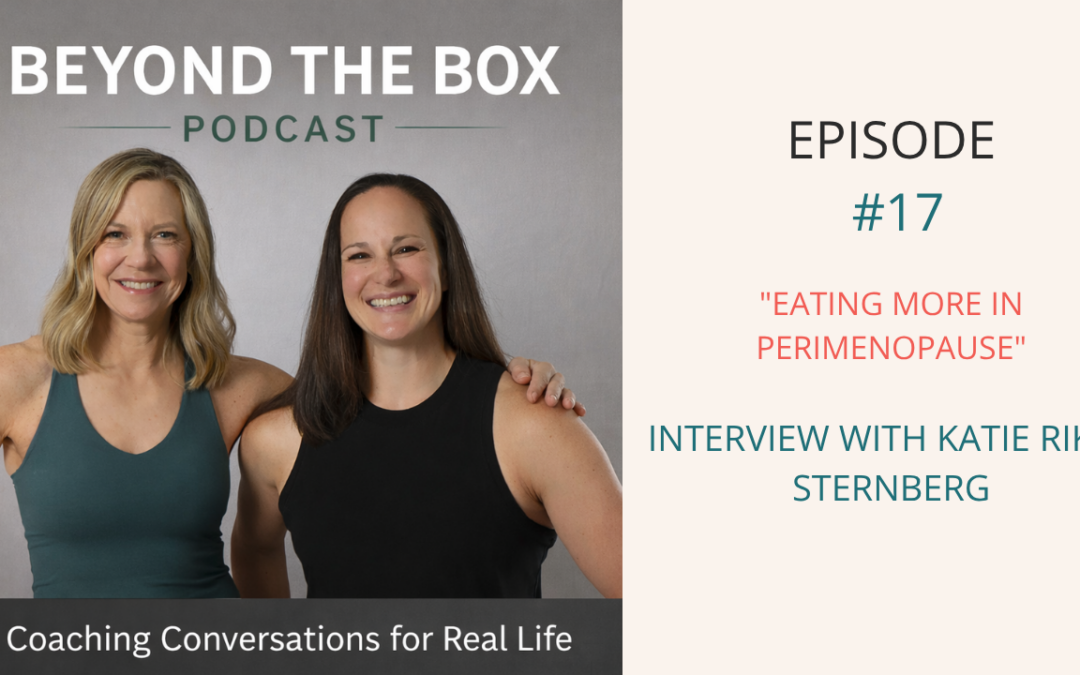
Eating More to Get Stronger in Perimenopause: Katie’s Story of Trusting Her Body Again
When Katie Riker Sternberg came to Beyond the Box Nutrition, she was a lifelong athlete in her mid-fifties doing everything “right” — strength training with a trainer, logging hours of cardio, eating clean — and watching her body refuse to cooperate. Over eight to nine months working with Coach Gwen, she rebuilt her relationship with food, exercise, and the voices in her own head. We sat down with Katie because her story is the one so many women in perimenopause and midlife are living right now: working harder than ever and being told the answer is to do even more.
When “Doing Everything Right” Stops Working
Katie wasn’t cutting corners. She knew how to eat, she was in the gym several days a week, she walked her dog, and she had the discipline of someone who had been physically active her whole life. And then, somewhere in her early fifties, the formula she’d trusted for a decade simply stopped working. Her weight started swinging. Her body changed in ways she didn’t recognize. The harder she pushed, the more frustrated she got.
This is one of the most common things we hear from women in perimenopause, and it’s also one of the most misunderstood. The hormonal shifts of this stage genuinely change how the body responds to food and training. What worked at forty doesn’t automatically work at fifty-five. That’s not a personal failure or a sign you’ve gotten lazy — it’s biology asking you to change your approach. The problem is that almost no one tells women that. Instead, they’re handed the oldest script in the book: eat less, move more.
The Bad Advice That Sent Her in the Wrong Direction
Here’s the part of Katie’s story that made us wince. When she went looking for answers, she got them from a trusted medical provider — a female doctor close to her own age — who told her to drastically slash her calories and cut her protein well below what her active body needed. Katie sat in that office and burst into tears, because something in her gut knew it was wrong. But the doctor was so certain, and Katie trusted the white coat enough to follow advice her own instincts were screaming against.
“If they are giving you advice that does not feel like it is sound, trust your intuition — ’cause you probably know more than you think you know.”
When Gwen looked at the full picture, the issue wasn’t that Katie was eating too much. She wasn’t eating enough — and she wasn’t eating enough of the right things to fuel the work she was doing. Hearing that was both a relief and a fresh source of frustration. As Sheena put it, Katie had been caught between her own instincts and an authority figure telling her the opposite, and that’s a setup for yo-yoing, because there’s no trusted path to stand on. The message Katie had absorbed since girlhood — that less is always more, that hunger is virtue, that more exercise is always better — runs deep for most of us, regardless of age. Undoing it is its own kind of work.
Eating More on Purpose — and Why It Felt Terrifying
So Gwen did the thing that sounds counterintuitive to almost every woman who’s spent decades dieting: she asked Katie to eat more. Not double her food. Not throw caution to the wind. A strategic increase, built around her activity level, her age, her medical and dieting history — a process we sometimes call reverse dieting, designed to pull the body out of the adaptive, fat-storing crouch that chronic under-fueling creates.
Katie’s honest reaction? It was scary. Decades of “starvation is best” don’t dissolve overnight. What got her over the hump wasn’t blind faith — it was the plain fact that what she’d been doing wasn’t working, paired with a willingness to try something different and give it time. Crucially, the focus shifted off of calories and onto protein, fiber, and the quality of what she was eating. She kept using Chronometer, the tracking tool we typically recommend, but reframed it entirely: instead of a tool for restriction, it became proof that she was eating enough.
That reframe matters. People assume tracking makes you obsessive and rigid. For Katie, it did the opposite — at the end of a week when the old voices insisted she’d eaten too much, she could look back and see, no, you’re right on target, go ahead and have the dessert. Tracking became a way to argue back against the chatter, not to feed it. And it left room for real life: a meal out in New York, a shared dessert in Chicago with no guilt attached, beautiful food with her family on a trip to Africa. Lean into the vegetables and fish, trust your intuition, and stop treating every trip like all bets are off.
Breaking Up With the Scale — and the Wine Habit
Katie has a hate relationship with the scale, and she decided she simply wasn’t going to get on it. We didn’t argue. The number on the scale is one of the least useful measures of progress for a woman building muscle and changing her body composition, and for Katie it never improved her mood or reinforced anything good. So she chose better barometers: how her clothes fit, progress photos, how she felt. She tried on a pair of linen pants that felt fantastic — and only afterward learned they were a size she hadn’t worn in years. She felt good before she knew the size. That’s the whole point.
The other quiet shift was alcohol. Katie noticed that her drinking had crept up during COVID, right as perimenopause arrived, and that even one glass of wine lowered the barrier to overeating and made her feel a little out of control. Nobody told her to quit. She experimented — a month off here, then there — until she realized she didn’t miss it, and now a seltzer in a wine glass at five o’clock does the job most nights, with the occasional martini or glass of wine kept as a genuine treat. We’re firm believers that this decision has to come from you. The second a coach issues a ban, the pushback kicks in. The real work is asking the honest question: why do I need this thing at five o’clock to relax? — and then deciding what you actually want.
Recovery, Surgery, and Learning to Slow Down
Midway through her journey, Katie had a hysterectomy. For someone whose identity was built on consistency and movement, weeks of no lifting and barely any exercise could have derailed everything. Instead, she treated it as a deload. She walked when she could only walk. She tuned into what her body needed, which was more rest, and she let herself rest without guilt. Her daughter pulled her into a needlepoint class right before surgery, and that became the outlet for her nervous energy — a reminder that play and hobbies belong in a healthy life too.
What strikes us most is what came before the surgery. Because Katie had spent months eating intentionally, fueling well, and cutting the processed food and excess alcohol, she went into the operation feeling strong and low on inflammation — and she set herself up for a fast recovery. Her biggest fear hadn’t been the surgery itself; it was whether she’d bounce back. She did, and she was proud of the healing her body was able to do. That pride is the empowering part. This was never just about changing her body composition. She knew something was off, she chose to take care of herself, and her body rewarded the investment.
Training for Life, Not for Punishment
Before BTBN, Katie was hyper-focused on cardio — not because she enjoyed it, but because she believed she had to, chasing minutes in specific heart-rate zones like they were a moral obligation. A doctor had told her she just wasn’t working hard enough, so she did more, until she re-injured the back that had already ended her running years. As Sheena pointed out, those training zones were built for endurance athletes preparing for races; they were never a measure of whether a midlife woman is “doing enough.” Somewhere along the way, women got taught to read them as a verdict on their worth.
Now Katie strength trains two or three days a week with a trainer she values, and fills the rest of the week by actually listening to her body. A leisurely three-mile walk with her husband and the dog, with a stop at the bakery. A half hour on the Peloton when a walk didn’t feel like enough. A day off when she’s traveling. She varies her cardio to protect her back, and she’s already problem-solving how to modify a cycling class so it doesn’t aggravate her injury — decisions she now makes on her own, without us telling her to. That’s exactly the goal. We always tell clients that our real aim is to work ourselves out of a job: for the day to come when you don’t need us because you’ve figured out what works for your body and your life.
“We train for life. I wanna be here. I wanna hopefully play with grandbabies on the floor for a long time.”
At fifty-seven, pressing fifty-pound dumbbells, Katie caught herself mid-set thinking, I am strong. She races the moving walkways at the airport on principle. Her dad is about to turn ninety, and she fully intends to follow him into a long, strong, capable old age.
What This Means for You
If Katie’s story sounds familiar, here’s what we’d want you to take from it.
The “eat less, move more” formula often backfires in perimenopause. If you’re under-fueling a body that’s working hard, more restriction usually digs the hole deeper. Adequate, appropriate fuel — especially protein — is what supports muscle, recovery, and how you feel in your clothes.
Your intuition is data. If advice doesn’t feel right in your gut — even from someone in a white coat — you’re allowed to question it and seek another opinion. You probably know more than you think.
The scale is optional. Clothes, photos, energy, mood, and strength are often far better measures of progress, especially when you’re building muscle and changing your body composition.
Flexibility beats restriction. Tracking can be a tool for permission and abundance, not punishment. Travel, dinners out, and the occasional drink or dessert can all live inside a healthy approach.
Rest and play are part of the work. Slowing down when your body asks for it isn’t falling off track — it’s how you heal, recover, and stay in this for the long haul.
Ready to Stop Working Harder and Start Working With Your Body?
If you’ve tried everything and you’re tired of being told the answer is to eat less and push harder, you don’t have to keep guessing on your own. We help women in perimenopause and midlife fuel their bodies, build real strength, and quiet the voices that have been running the show for decades — all built around your real life, not a rigid plan. Book a free consult with us at Beyond the Box Nutrition, and let’s figure out what actually works for you.
Common Questions About Eating More in Perimenopause
Why am I gaining weight in perimenopause even though I’m eating less and exercising more?
Hormonal shifts in perimenopause change how your body uses fuel, and chronic under-eating can push your body into an adaptive, energy-conserving state that makes things harder, not easier. Many women are unknowingly under-fueling the work they’re doing, especially on protein. Increasing food strategically — under guidance suited to your activity, age, and history — often supports better results than cutting further.
Is reverse dieting safe, and will it make me gain weight?
Done thoughtfully, increasing your intake isn’t about overeating or losing control — it’s a gradual, strategic process based on your individual activity level, medical history, and dieting history. The goal is to bring your fueling up to an appropriate level so your body isn’t stuck in a deficit-and-binge cycle. Working with a coach helps you do it in a way that builds strength and supports your body composition rather than working against it.
Do I have to weigh myself to track progress?
No. The scale is just one metric, and for many women it’s a misleading and discouraging one — particularly when you’re building muscle and losing fat at the same time. How your clothes fit, progress photos, your energy, your mood, and your strength in the gym are all meaningful ways to measure progress without ever stepping on a scale.