

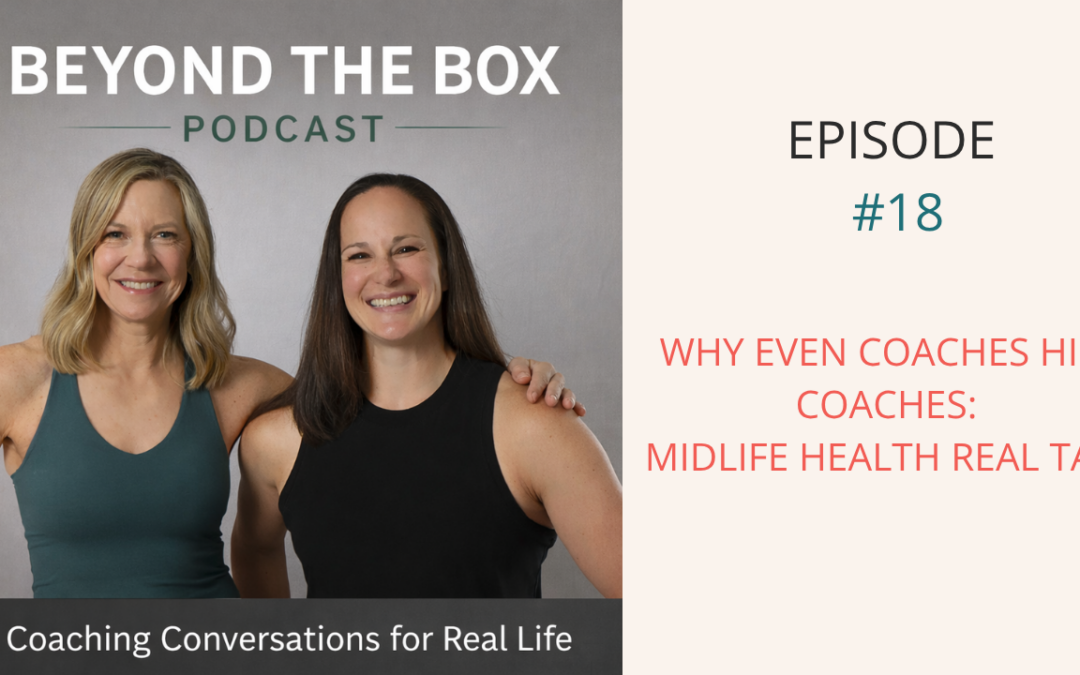
Why Even Coaches Hire Coaches: Real Talk on Midlife Health, Diet Culture, and Choosing Hard
We hit record with dinner already in the oven and a marathon eight weeks out, and honestly, that felt like the right way to start. This episode of the Beyond the Box podcast is just the two of us, Gwen and Sheena, catching up after a busy summer with no polish and no highlight reel. If you are a woman in midlife who has followed every program, counted every macro, and still feels like your body is doing its own thing, this one is for you. It is about what it actually looks like when the people who coach for a living have to work at their own health too.
The “30 Grams of Protein or You Failed” Trap
Somewhere along the way, social media decided there were rules. You have to hit 30 grams of protein at breakfast. You have to do it before a certain hour. Miss it, and apparently the day is already a wash. We see this land on smart, capable women constantly, and it does real damage, because it turns one ordinary morning into a pass or fail test you have already failed by 8 a.m.
Here is the thing. Gwen had sourdough toast with cashew butter and homemade fig jam for breakfast. Maybe six grams of protein. She did not lose her muscle. Nothing bad happened. She got her protein in across the rest of the day, the way most of us actually eat, with Greek yogurt, a kale salad with turkey bacon and egg, chicken for dinner. Your body does not have a clock that shuts down muscle production at 7:30 because you had toast. That is not how any of this works.
What these arbitrary rules really do is set up the “screw it, I’ll start tomorrow” spiral. You miss the impossible number, you feel like you blew it, and you write off the whole day. We would rather you zoom out. If you are getting zero grams of protein at breakfast, what would it look like to get ten? To start with a couple of eggs and build from there? Progress beats perfection every single time, and nobody is coming to take your muscle away because you enjoyed your food.
“There are these arbitrary rules that are so specific that people just get so caught up in it. It sets up this pass fail. And it’s like, no, if you are getting zero grams of protein at breakfast, how about getting ten? How about starting with a couple of eggs and working your way up?” — Gwen
Even Coaches Hire Coaches (And That Is the Whole Point)
Sheena started her marathon training solo. She is a coach, a two-time Olympian, and she figured she could program for herself. By February she was hurt, because she pushed harder than the moment called for. So she did the thing she tells her own clients to do. She hired a coach. Someone to keep her in her lane while still pushing her, someone whose progressions she could actually see and learn from. Two months in, she is stronger and healthier for it.
And Gwen? She rehired Sheena. Call it Sheena 3.0. What matters is why. It was not because anything was broken. It was because she wanted accountability, honest feedback, and someone who would not judge her. That relationship took years to feel safe. It only works because Gwen tells the truth in the app, the good days and the “I felt like garbage today” days, and Sheena adjusts the plan around real life instead of a fantasy version of it.
This is the reframe we want you to hold onto. Hiring help is not an admission of failure. Surgeons who have trained for twenty years still study new techniques, new equipment, new trials. Coming back to a coach is a check-in, not a confession. Our lives change, our goals change, we get injured, we move, we hit a season where things are just hard. Asking for support is what strong, self-aware people do. It is not the thing you do when you have run out of options.
Success You Can Actually Feel (Not Just Weigh)
When Gwen’s sleep fell apart this year, Sheena did not reach for the scale or pile on more training. She looked at recovery, heart rate variability, resting heart rate, and Gwen’s own words about how she felt. Then she added one zone two session a week and pulled volume back where it needed to come back. Within days, Gwen’s HRV climbed from 49 into the 60s and her recovery scores went green. She could feel the difference and she could see it, and that combination is what keeps a person going.
That is the model we use with clients too. We call them non-scale victories, and they are not a consolation prize. How is your quality of life? Is your mood steadier? Are you snapping at the people you love less? Are you sleeping? Do you feel a little more at home in your body than you did a month ago? Those are real, measurable wins, and for a lot of women they matter far more than a number that was never telling the full story anyway.
None of it works without honesty, though. The data only goes so far. Your wearable can tell you that you are in the green, but if you are having a genuinely rough day, that matters just as much, and we need to hear it. The best programming in the world falls apart without that feedback loop. Trust, communication, and small honest adjustments week over week are what actually move you forward, even when a smart pullback week feels like going backward.
Stepping Away, Not Quitting: When Your Body Is Sending Signals
Business was slow this spring, so Gwen took on extra virtual coaching work for a physician. A third job. She took it lightly, figured she would see how it went. It did not go well. She was waking up between 3:30 and 4:30 in the morning several days a week, her training slid, her eating habits changed, and she started feeling like an imposter for stress-eating while coaching other people through the exact same thing. Ten weeks in, she stepped away.
Notice the word. Stepping away, not quitting. She was very intentional about that, because she was not walking away from something, she was walking toward better health. And here is what we want you to really sit with. The 3:30 wake-ups, the tanked motivation, the food falling apart, those were not character flaws. They were signals. As women, our instinct is so often to push harder, to ask what we are doing wrong, to tell ourselves we should be stronger than this. But your body keeps the score, and sometimes the strongest thing you can do is listen to it.
Alcohol, food, shopping, scrolling, TV, all of it can become a coping mechanism when stress is running the show. That is not a moral failing, it is human. The work is not to never cope. It is to notice the pattern, interrupt it sooner, and stop treating your own humanity as evidence against you. Gwen turning her stress-eating into a moment of relatability instead of shame is the whole practice in one move.
“I’m very intentionally not saying the word quitting. I’m saying stepping away, because I’m stepping toward better health.” — Gwen
Choosing Hard: Running New York for a Reason
Sheena is running the New York City Marathon on November 1st for Fred’s Team, the fundraising arm of Memorial Sloan Kettering. To get accepted you need a deep connection to MSK, and hers could not be deeper. Her son Gus received a targeted chemotherapy treatment there that saved his eye and killed the cancer in it, a treatment that did not exist a decade ago, when the only option would have been removing the eye entirely. They left Chicago to get him that care. Running twenty-six miles, in her words, is nothing compared to what MSK gave her family. Every dollar she raises goes to pediatric cancer research, and she is well past $16,000 and climbing.
The mindset underneath it is the part we cannot stop thinking about. When Gus was diagnosed, nobody chose that. It was forced on the family with less than twelve hours to decide how they wanted to respond. What Sheena learned in that season is that even when the situation is completely out of your control, how you show up is not. There was always another door, even when the doors were awful. The marathon is different. This time she is choosing hard on purpose. She spent her whole life believing she was not a runner because she was not good at it, and now, in her forties, she is deciding to get freaking good at it anyway.
That reframe is available to every one of us, and it has nothing to do with running. You take the thing in front of you, hard as it is, and you decide what you want to make of it. Sheena and the other moms she trains with send each other voice notes mid-run that say the same three words: we get to do this. Choose your hard. Then celebrate it instead of fearing it.
“I did have a choice in how I wanted to respond every day. I had that choice. Choose your hard, and celebrate it instead of fearing it.” — Sheena
What This Means for You
There is a lot in this conversation, so here is what we most want you to carry out of it.
Ditch the arbitrary rules. A specific gram target at a specific hour is not the difference between health and failure. Consistency across your whole day beats a perfect breakfast every time, and one imperfect meal never cancels your progress.
Asking for help is a strength move. Hiring a coach, or going back to one, is a check-in, not a confession. The people who are best at this still lean on other people. So can you.
Measure what actually matters. Your mood, your sleep, your energy, how you feel in your own skin. Those non-scale victories are real data, and they usually tell you more than the scale ever did.
Your body’s signals are information, not weakness. Poor sleep, low motivation, and stress-driven habits are your body asking for a change. Listening sooner is not giving up. It is self-awareness, and it is a skill you can build.
You get to choose your hard. You cannot control everything that happens to you, but you can decide how you respond and what you build from it. Pick the hard thing that means something, and let it ground you when it gets tough.
Ready to Stop White-Knuckling It on Your Own?
If any of this hit close to home, the tired, the trying everything, the quiet sense that your body is working against you, we want you to know you do not have to figure it out alone, and you are not doing it wrong. We built Beyond the Box for exactly the woman who has done all the things and is still waiting for something to finally fit. No shame, no gimmicks, no pass-fail rules. Just two coaches who have been there, meeting you exactly where you are.
Grab a free consult with us and let’s talk about what would actually work for your body and your life. Book with Sheena or with Gwen, whichever feels right. We would love to meet you.
Common Questions About Midlife Nutrition and Coaching
Do I really need 30 grams of protein at breakfast in perimenopause? Protein matters in midlife, especially for holding onto muscle, but a specific number at a specific hour is not a magic threshold. What counts is your total intake across the day and doing it consistently. If mornings are hard, start small with a couple of eggs or some Greek yogurt and build from there. Missing a target at breakfast does not undo your progress.
Is it a waste of money to hire a coach if I already know the basics? Not at all. Knowing what to do and doing it consistently, in a way that fits your real life, are two different things. A good coach brings accountability, honest feedback, and adjustments based on how your body is actually responding, not a generic plan. Even experienced athletes and coaches work with coaches for exactly this reason.
How do I measure progress if I’m not focused on the scale? Look at the non-scale victories. Better sleep, steadier mood, more energy, improved recovery metrics like heart rate variability, and simply feeling more at home in your body are all meaningful signs of progress. Many women find these markers tell a truer story than weight, and they tend to reflect the changes that actually last.